Why MLOps Bottlenecks Become a Breaking Point for AI Projects? Gartner reports that nearly 70% of machine learning projects never reach production. The lack of smart ideas is not the issue- i
Why MLOps Bottlenecks Become a Breaking Point for AI Projects?
Gartner reports that nearly 70% of machine learning projects never reach production. The lack of smart ideas is not the issue- it is all the roadblocks that stop teams from scaling up or keeping things reliable. That is where MLOps (Machine Learning Operations) steps in. It borrows heavily from DevOps but is built for machine learning.
MLOps handles everything: Data pipelines, training, deployment, monitoring- the whole process.
Even with tools like Kubeflow, MLflow, and Airflow, teams still run into the same headaches. Pipelines break. Training costs rise too fast. Models crash without warning.
This article examines six common bottlenecks and how to address them. Each section outlines the problem and solution, with examples from real projects.
👉 Use this tutorial as a reference for overcoming MLOps issues; bookmark it or share it with others.

Bottleneck ❶: Slow & Costly Training
Problem
Large models require substantial GPU time and money to train; a single run can cost thousands of dollars and take days.
Solution
- Start with GPU optimization. Techniques such as CUDA tuning and TensorRT can significantly accelerate performance.
- Then there is distributed computing. Tools like Horovod and Ray let you distribute the workload across multiple GPUs or even different machines. That way, training finishes faster and costs less.
Implementation Example
Flexiana’s engineering team helped a healthcare client move from training on a single GPU to using distributed clusters. Training time dropped from 72 hours to under 20. Not bad.
📌 If you want to dig deeper, check out NVIDIA GPU Optimization Whitepapers– they lay out how tuning your GPUs can save both time and money.
Bottleneck ❷: Fragile ML Pipelines
Problem
ML pipelines often fail. Change one line of code or a piece of data, and suddenly all the experiments come to a stop. It is frustrating and wastes hours.
Solution
- Automate as much as possible. Tools like Kubeflow Pipelines and MLflow help make workflows reproducible and a lot less fragile
- Orchestration frameworks like Apache Airflow and Prefect keep things in order- so if one step fails, the whole pipeline does not collapse.
Implementation Example
This is not just theory. Pipeline automation reduces failures by half, according to Google Cloud. Systems remain robust when data and models change because pipelines are treated as code and are subject to automated tests.
📌 Reference: Google Cloud MLOps: Continuous delivery and automation pipelines
Bottleneck ❸: It Worked on My Machine
Problem
A model may function well on a laptop but malfunction in production due to GPU limitations, dependencies, or environmental issues.
Solution
- Models and datasets can be versioned using tools such as DVC or Git LFS.
- To help teams understand how each model was trained, tools such as MLflow or Neptune.ai can monitor the model lineage.
- And do not forget environment validation- test across GPUs and containers before deploying anything.
Implementation Example
Microsoft Azure shows how this works in practice. When teams use versioning and reproducibility best practices, models move smoothly from development to staging to production. Tracking everything avoids the “works on my machine” problem.
📌 Reference: If you are curious, Microsoft’s own documentation has plenty of real-world examples- look up Azure Machine Learning’s train and deploy guides.
Bottleneck ❹: Data That Does not Scale
Problem
Pipelines that run fine with a few gigabytes often collapse when data grows to terabytes. Training slows down, costs rise, and teams start getting unreliable results.
Solution
- Scalable ingestion with tools like Apache Spark and Delta Lake. They handle massive datasets, whether teams are streaming or doing batch jobs.
- Cloud‑native storage services like AWS S3 and Google BigQuery grow flexibly with demand.
Implementation Example
Databricks ran benchmarks showing that Delta Lake can stream hundreds of gigabytes of data at steady speeds. That means teams can actually train on terabytes without breaking pipelines.
📌 Reference: Databricks Delta Lake Documentation- What is Delta Lake?
Bottleneck ❺: Broken Deployments
Problem
Traditional CI/CD pipelines often omit critical steps for machine learning. They skip data validation, model testing, and real-time monitoring. The result? Unexpected downtime and wasted work.
Solution
- ML‑aware CI/CD means adding model validation, checking your data, and making sure monitoring is built into your DevOps pipelines.
- Use safe rollout strategies, such as canary releases and rollback plans, to mitigate risk with every deployment.
- Automation tools such as GitHub Actions, Jenkins X, and Azure ML pipelines handle the unique needs of ML deployments.
Implementation Example
Microsoft Azure’s ML deployment guides show that when teams build these checks into their CI/CD pipelines, they experience fewer surprises. Recovery gets faster, and deployments are just safer.
📌 Reference: Azure Machine Learning Documentation- Train and deploy ML models
Bottleneck ❻: Silent Model Failure
Problem
Models do not always fail loudly. They can quietly degrade, causing damage if no one is watching.
Solution
- Prometheus and Grafana provide real‑time performance monitoring by tracking metrics as they occur.
- Tools like Evidently AI and Fiddler AI detect data shifts and accuracy drops fast.
- Automatic alerts notify the team instantly when issues occur, enabling rapid response.
Implementation Example
Case studies from Google Cloud demonstrate how monitoring detects drift early, even in the banking industry, allowing teams to address silent issues before clients become aware of them.
📌 Reference: Google Cloud MLOps: Continuous delivery and automation pipelines
The Business Impact of MLOps Bottlenecks

Let’s be real- MLOps bottlenecks are not just a minor technical glitch. They extend into the business side in various painful ways. If model training takes too long, pipelines break, or models quietly get worse over time. Firms do not just get upset; they lose money, they risk breaking the rules, and customers start looking elsewhere.
1. Revenue Loss
- Retail: When recommendation engines fail to update with fresh data, customers become frustrated by odd product suggestions or by items that are no longer in stock. It will quickly kill the conversion rates.
- Finance: It is even more serious in the Finance industry. If a company’s fraud detection algorithm quietly drops in precision, it starts failing to catch suspicious transactions- and minor decreases can lead to multi-million-dollar losses.
McKinsey is clear: if you can not get AI working in daily operations, you are missing out on profit. But fragile pipelines keep blocking the way. McKinsey found that companies that scale AI see 20–30% jumps in EBITDA, but most don’t reach that level because their MLOps setups are too weak.
2. Compliance Risks
- Healthcare: Healthcare is not just about new tech; it is about getting things right. If hospital models become outdated or develop bias, doctors could misdiagnose patients. If they fail to monitor model drift, they could break HIPAA or FDA rules. That is not just a technical error- that is a major compliance mess with real consequences.
- Banking: Banks deal with their own problems. Laws such as Basel III and GDPR require banks to explain their models and show their work.
Gartner says that without strong MLOps controls, banks cannot keep up, and that means fines and reputational damage. Gartner reports that nearly 70% of machine learning projects never reach production, and bottlenecks are often the cause.
3. Customer Churn
- Telecom: Telecom companies rely on predictive churn models to identify customers about to leave. If those models fail and no one notices, they lose people they might have retained.
- Streaming Services: When recommendations go sideways, users do not just get annoyed- they choose an alternative provider.
Deloitte puts it simply: MLOps is the key factor behind AI that actually delivers, and it is how you keep customers happy.
MLOps bottlenecks are not simply an IT nuisance- they are a business threat. Every broken pipeline, every silent model failure, and every hour of downtime damages earnings and reputation. Companies that treat MLOps as a real strategy, and not simply a temporary solution, protect their profits, stay on the right side of the rules, and keep their customers coming back.
How Flexiana Approaches These Challenges
Most teams treat bottlenecks as separate issues. Flexiana treats them as interconnected components of a single system.
We do not use quick fixes. We build systems that stay reliable for months or years. Here’s how.
- We ensure compute, storage, and orchestration grow together so nothing falls behind.
- Our data pipelines can ingest and process terabytes without failing.
- We integrate ML-specific checks and monitoring right into the CI/CD pipelines, so deployments stay smooth and issues get caught early.
Flexiana has helped healthcare and finance companies. The clients move from messy, unreliable pipelines to reliable, scalable MLOps systems. The results? Training costs dropped, deployments stopped breaking, and those silent failures get detected before hitting production.
👉 Ready to make your ML systems actually work at scale? Reach out to Flexiana and see how we do it.
Best Practices for Building Scalable MLOps Systems
Scaling MLOps isn’t just about adding new tools. It’s about building systems that don’t fall apart when your data, models, and teams grow. This is a simple guide that includes a maturity model, a checklist, and a summary of how the components work together.
Checklist of Core Practices
✔️ Reproducibility: Version your models, data, and code. Use DVC, Git‑LFS, or MLflow to keep track of changes.
✔️ Monitoring: Monitor data live, catch drift, and send alerts through tools like Evidently AI, Grafana, or Prometheus
✔️ CI/CD Integration: ML pipelines should be managed like software pipelines. Automate testing, validation, and deployment with GitHub Actions, Jenkins X, or Azure ML. The less manual work, the smoother things run.
✔️ Governance: Follow data privacy rules like GDPR or HIPAA. In regulated fields, keep audit records and explain how models work.
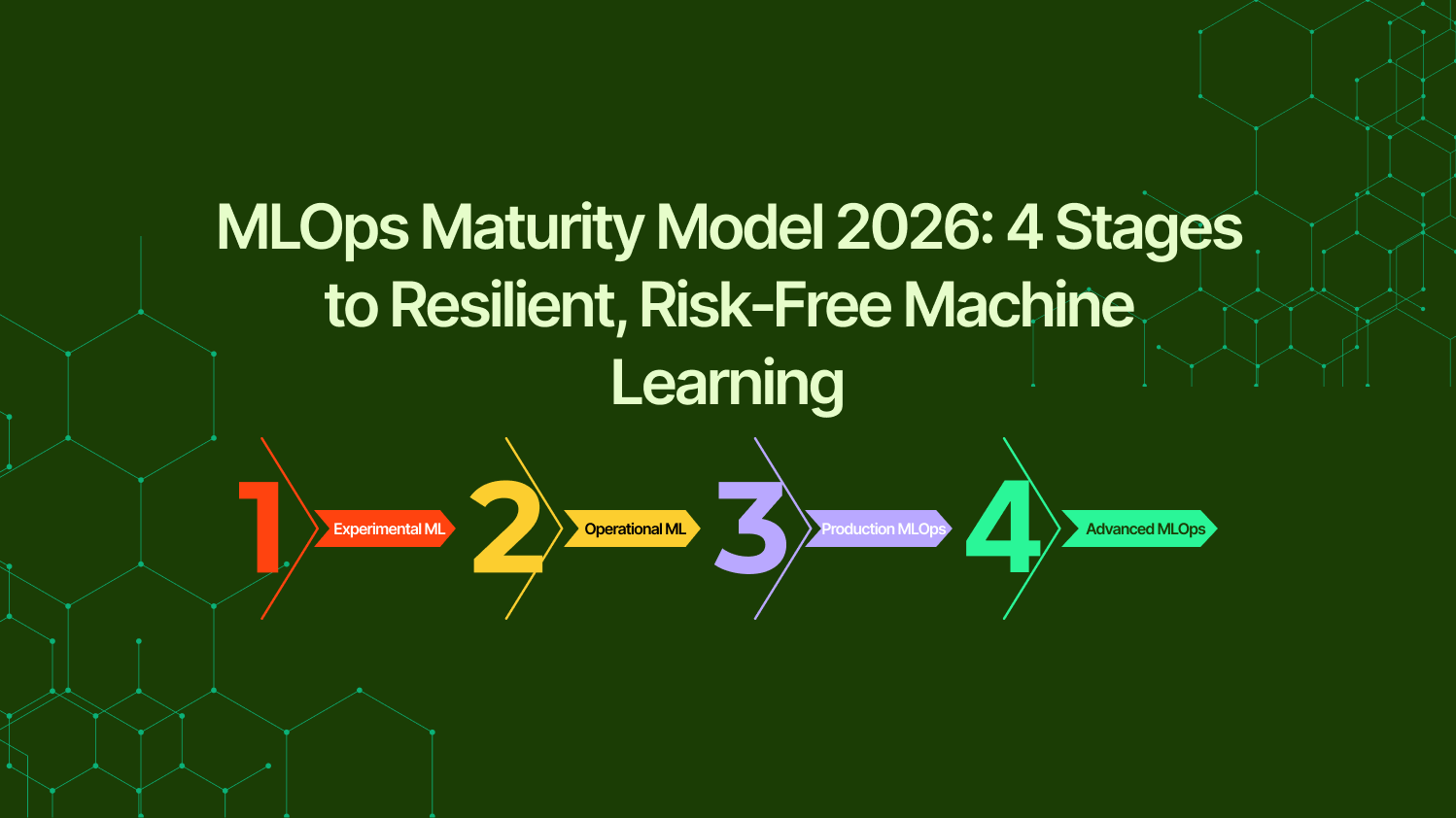
MLOps Maturity Model
| Level | Characteristics | Tools & Practices | Risks if Stuck Here |
| Beginner | Manual training, scripts run by hand, little or no monitoring. | Jupyter notebooks, single GPU. | Pipelines are fragile, and models only run on one machine. |
| Intermediate | Automated pipelines, version control, and basic CI/CD. | MLflow, Kubeflow, Airflow, DVC. | Hard to scale, costs rise quickly. |
| Advanced | Full orchestration, strong monitoring, compliance checks, and cost control. | Horovod, Ray, Delta Lake, Prometheus, Canary deployments. | Reliable, scalable systems with less downtime. |
How It All Fits Together
Think of MLOps as a loop:
Data Ingestion → Training → Validation → Deployment → Monitoring → Feedback Loop
- Data is ingested and stored in scalable storage systems such as S3, BigQuery, or Delta Lake.
- Training uses distributed computing with Ray or Horovod.
- Validation runs automated checks on your data and models.
- Deployments run through CI/CD pipelines with built‑in safety measures.
- Monitoring watches data in real time, spots drift, and alerts the team.
- When performance falls, the feedback loop triggers retraining.
Key Takeaway
If teams want scalable MLOps, cease fixing issues individually. Build a connected system where the data, compute, deployment, and monitoring all grow together. Teams that level up from the basics to advanced orchestration see fewer failures, lower costs, and actually make AI work at scale.
Comparing Popular MLOps Platforms
Teams should choose an MLOps platform based on what they value most—flexibility, simplicity, or enterprise support. Here’s a clear look at the most common tools and how they stack up.
| Platform | Strengths | Weaknesses | Best Use Cases |
| Kubeflow | Works well with Kubernetes, good for pipelines | Hard to set up, steep learning curve | Big teams already using Kubernetes |
| MLflow | Simple tracking, model registry | Weak orchestration, not for complex pipelines | Tracking experiments, managing models |
| Airflow | Reliable scheduling, widely used | Not built for ML, no model tracking | Data pipelines, ETL + ML workflows |
| Prefect | Easier than Airflow, cloud option | Smaller ecosystem, less ML focus | Quick setup, lightweight orchestration |
| Ray | Scales training and serving | Needs more engineering effort | Large-scale training, reinforcement learning |
| AWS SageMaker | Managed service with training, deployment, and monitoring | Vendor lock-in can get expensive | Enterprises on AWS needing end-to-end ML |
| Azure ML | Strong Microsoft integration, CI/CD, compliance | Complex pricing, tied to Azure | Enterprises needing governance and compliance |
Commentary: Open‑Source vs. Enterprise
Open-source tools like Kubeflow, MLflow, Airflow, Prefect, and Ray allow teams to get started for free. They have a lot of freedom to tweak and customize, but they will need knowledgeable engineers to set everything up and keep it running smoothly. These tools really shine when the team is comfortable working practically with the technology.
On the other hand, enterprise platforms such as AWS SageMaker and Azure ML handle much of the heavy lifting for teams. They handle training, deployment, and monitoring for them, plus teams get built-in security and compliance. It is definitely more expensive, and teams are tied to a specific vendor, but they do not have to worry as much about the day-to-day technicalities.
Future Trends in MLOps
MLOps moves quickly- today’s methods won’t last long.
Here’s what’s coming
- AI observability is not limited to tracking models. Now, teams want tools that actually explain what is happening inside those models after deployment. People need answers, not just numbers.
- Foundation model deployment is a unique challenge. Handling large models like GPT and other LLMs requires updated infrastructure and new ways to scale. You can not just plug them in and hope for the best.
- Edge MLOps is picking up speed, too. Teams are running models right where the data is made- on devices or local servers- so decisions happen faster.
- AutoML pipelines are also getting smarter. They cut down busywork so teams can focus on what matters.
Impact of LLMs
LLMs have changed the game
- They demand a lot of computing power and distribute training across many machines.
- Additionally, you need closer supervision to address bias, drift, and performance issues.
- Standard deployment strategies do not work anymore- these models are simply too large.
Predictions
- Sustainability is taking the spotlight. People want Green AI- training that saves energy and uses carbon-aware scheduling.
- Federated learning is gaining popularity, too. It lets teams train across different devices without moving data around, which helps with privacy and compliance.
- Hybrid cloud setups are now common. Combining cloud and on-premises helps balance flexibility, security, and cost.
Pipelines and model observation are no longer the only aspects of MLOps. It’s about scale, ethics, sustainability, and getting models running wherever you need them. The field’s growing fast.
Quick Answers to Key Questions (FAQs)
Q1: What are the biggest challenges in MLOps?
Teams dealing with fragile pipelines that break when least expected, scaling headaches, models that can not be reproduced, deployment flops, and models silently becoming less effective without anyone noticing.
Q2: How do you fix fragile ML pipelines?
Automate as much as possible. Use orchestration tools. Treat pipelines like code- version them, test them, and do not rely on guesswork. That way, they won’t fall apart every time something changes.
Q3: What tools help with MLOps monitoring?
Prometheus and Grafana let teams watch metrics in real time. If teams want to catch drift before it messes things up, Evidently AI and Fiddler AI offer support.
Q4: How does Flexiana differ from other MLOps providers?
Flexiana approaches MLOps like real engineering. We do not just get things running- we build systems that keep running, even months or years after launch.
Q5: How can teams make ML models reproducible across different environments?
Modify your models and data. Before going live, always test in multiple contexts and keep notes on where everything started.
Q6: What’s the best way to handle data growth from gigabytes to terabytes?
Use scalable technologies, such as Delta Lake or Apache Spark. Use cloud storage that scales with your data growth.
Q7: How do you prevent silent model failures in production?
Use alerts, drift detection, and continuous monitoring to resolve problems quickly before they get worse.
Conclusion: Turning Bottlenecks Into Reliable Systems
Most machine learning projects don’t fail because the ideas are weak. They run into trouble because of the same old problems- slow training, clunky pipelines, data that does not scale, deployments that break, or failures that nobody notices.
The good news is that each of these problems has a practical fix. GPU optimization, automated pipelines, proper versioning, scalable data systems, ML‑aware CI/CD, and drift detection- these are not just buzzwords. They work. And when they are combined into a real, system‑level strategy, the chances of success go way up.
Flexiana’s work with enterprise clients shows that treating MLOps as engineering- not patchwork- keeps models reliable long after launch. It is about building scalable foundations, not just solving one issue at a time.
The post Common MLOps Bottlenecks (and How to Fix Them): Proven Solutions for Scalable AI Deployment appeared first on Flexiana.